
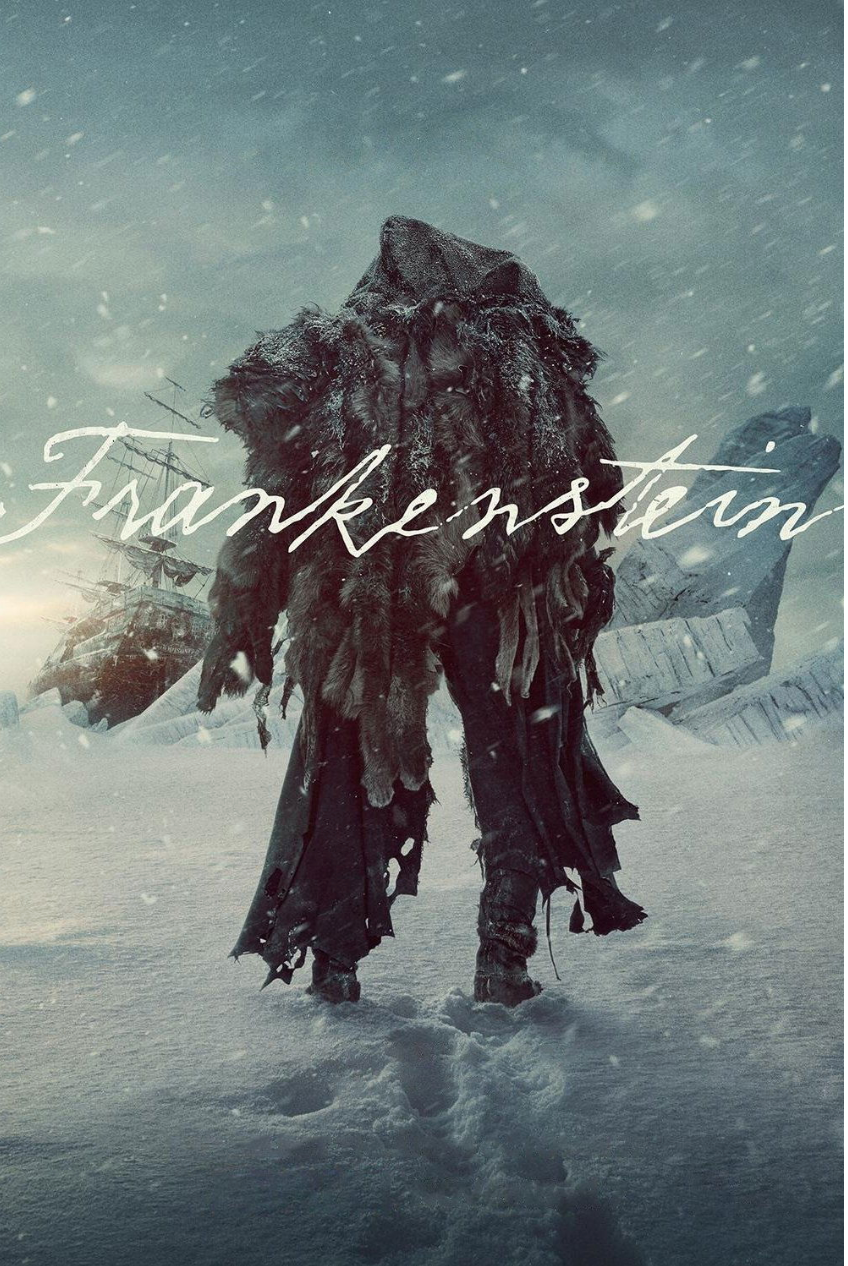
Frankenstein (2025) Is a Lot More Guillermo del Toro’s than It Is Mary Shelley’s: Exploring the Story’s Latest Adaptation with the Original Fresh in Mind
By Lisa Perini ‘26 (Head of Communications)
Disclaimer: The following article contains some spoilers for Frankenstein
It’s not often that a book being taught in school gets adapted into a movie while you’re reading it. So, when I realized I’d be reading Mary Shelley’s Frankenstein around the same time that Guillermo del Toro’s Frankenstein would be released, I was very excited — partly because it meant we might get to watch a movie in English class, but also because I’d get to see the real-time reinvention of a classic story.
I was really interested in how the book-to-movie pipeline would play out for this movie. Guillermo del Toro seems extremely passionate about being the one to adapt Frankenstein, even referring to it as his Bible in an interview. My expectations were high, not only because one of today’s best gothic directors was turning the gothic novel into a film, but also because of his long-standing personal connection to the story.
I’m still not quite sure whether my expectations were carried out. I did love watching this movie; however, it was hard to ignore how different it is from the book. I’d argue it was too different from the book. Del Toro takes many creative liberties with this movie, but he does so to the point where it’s almost an entirely different story.
I never expect the film version of a book to be perfectly adapted. However, I reasonably expect the movie to retain the major plot points of the book. This movie doesn’t really do this. It’s referred to as Guillermo del Toro’s Frankenstein because he rewrites the story in a way that’s hardly reminiscent of Mary Shelley’s original novel. His changes range from being logical in ways, such as moving up the time period from the 18th century to the late 19th century to allow for the inclusion of newer technologies like photography, to being irrational in ways, such as completely erasing pivotal characters like Justine Moritz and Henry Clerval.
Other notable changes are the events. Instead of Victor (Oscar Isaac) creating the creature (Jacob Elordi) in secret, as he did in the book, the film makes it so that those in Victor’s inner circle are aware of his experiments the entire time, and that there’s actually someone funding his research to create the creature. For part of the movie, Victor also tries to be a father figure of sorts to the creature. Instead of being so disgusted that he abandons his creation, as in the novel, Victor briefly attempts to raise it before becoming impatient and attempting to kill it.
Still, I see what del Toro was trying to achieve with these changes; he made it clear his intention with this movie was to capture the “human spirit” of the story (as told to Variety), which I’d argue he succeeds in doing. I honestly enjoyed seeing the way some of his changes played out. He gave Elizabeth (Mia Goth) a much bigger role in his adaptation. One of the things I didn’t love when reading the book was how passive Elizabeth felt, so I’m glad del Toro changes this by making her much more involved. Instead of being a mere object of Victor’s affection, Elizabeth becomes an essential part of the creature’s understanding of humanity.
I will forever sing praises about Mia Goth’s performance. Despite already being familiar with her work and having loved her in Ti West’s X Trilogy, I saw a new side of her acting. She brought such warmth to the screen — a big contrast from playing a psychopath in Pearl (2022). No pun intended, she’s a star. Elizabeth was definitely one of my favorite parts of the movie. Not only did Mia Goth bring so much dimension and delicateness to her character, but she also had incredible chemistry with her co-stars. I was especially impressed by her and Jacob Elordi’s chemistry. In interviews, she spoke about how she worked to build an off-camera relationship with Elordi to help; she took the time to care for him by sending ginger shots and Vitamin C, along with pizza, so that their dynamic and trust would be properly built when the time to film came. She embodied the role of Elizabeth with such grace, showing extreme empathy for the world around her and for the creature. Elizabeth is the first character in the film to treat the creature with any ounce of respect. When everyone else is treating him as an atrocity, Elizabeth makes a genuine connection, something the creature visibly carries with him throughout the rest of the film.
Another highlight of the film in terms of acting for me was Jacob Elordi. I felt a lot of empathy for his version of the creature, much more than I did when reading the book. I think this is partly because I do better with visuals, but that in no way dims the poignancy of Elordi’s performance. Similar to the novel, as the creature encounters more people, his views on the world shift. His interactions with Victor in the early stages of his life build a lot of resentment. The creature senses Victor's impatience and distaste, which contributes to his defiance of his creator. For example, Victor was unsuccessful in teaching the creature how to speak due to how much anger he held towards the creature. However, the blind man succeeded in doing so because he approached the creature with compassion. It was the same thing with Elizabeth; he listened to and protected her because of how she approached him. Elordi embodies these different dynamics incredibly well, and he expresses vulnerability, even in the parts of the film that aren’t narrated by him. It may be premature when I say I think he’ll be a frontrunner in the upcoming awards season, but this performance is one-hundred percent worthy of awards. He was nothing short of amazing. Not only was his physical transformation astonishing, but he also brought so much depth to the character. It’s crazy to think he wasn’t the first choice but the replacement, because I don’t think anyone else would be able to achieve what he did. From his first to his final moment, you could feel his longing to be understood. It was really heartbreaking to watch at times, seeing the pureness behind his intentions being met with aggression. There’s a moment when he tells Victor, “to you I am obscene, but to myself I simply am,” and I think that perfectly sums up the creature. He was unwillingly brought into a world that didn’t accept him, and he faced the harshness of it. His presence, while a disruption to some, was merely his attempting to live the way we all do. Seeing him grapple with the knowledge that he’s unwanted, even by his own creator, truly brought me to tears. However, it was beautiful to watch. It was raw and unapologetic. Elordi made the creature, a deeply misunderstood character, lovable, showing that the real monster isn’t the one with green-hued flesh and covered in stitches, but the one who tried controlling the wind instead of adjusting the sails: Victor.
I feel like the film paints Victor in a much more negative light, which I kind of love. I didn’t like him that much when I read the book, and it was hard at times, being annoyed by the person you’re supposed to root for. Despite being a terrible character in both versions, the novel paints Victor as a sort of “Tragic Hero.” I think Oscar Isaac did a very good job acting; however, it wasn’t really a standout performance. His other two co-stars definitely made a longer-lasting impression. Still, he was great, as expected. I think he handled the script well and made the most of his character. He definitely had a more “mad scientist” approach to Victor than I would have liked to see, but I enjoyed seeing him act. Having been somewhat anti-Victor already, I didn’t cling to his performance. I saw it as him simply playing a detestable character. His portrayal was also really similar to his role in Ex Machina (2014), a movie we watched in English class this year, so the two performances blended together a lot. Despite being the protagonist, he never felt too much like the focal point of the film, but that’s not an issue that lies in his acting. Rather, I think Guillermo del Toro chose to fixate on the creature, leaving Victor on the back burner at times.
Along with incredible performances, Frankenstein is filled to the brim with stunning visuals. The landscapes are every bit as magnificent as they’re described in the book, which completely immerses the viewers. The film is also incredibly colorful. I wasn’t expecting it to be, as I was previously under the impression that a gothic film’s color palette would be gloomy. Every frame contains vibrant colors, making it a delight to watch. I was especially drawn to the use of color in the film. I think the colors were very masterfully employed as motifs and as instruments to convey emotion. In both the set design and in costume design, the colors’ lightness contrasts with the tone of the movie, adding not only to the film’s beauty but also to its layers. As the film progresses, the color patterns become more apparent, which elevates the whole viewing experience.
I don’t think I’ve felt this strongly about a new movie in a while. Thoughts were overflowing in my brain as I watched and in the days that followed. There’s no denying that it’s beautifully crafted, from its writing to costume design and cinematography. Apparently, much time and effort went into every single detail. The characters’ essences are amazingly captured, with the actors bearing the solemnity of the story with some lighter touches. The story definitely has the spirit of the original, even though it doesn’t really reflect the actual narrative all too well. The changes were needed for the movie, especially because the original plot may not be the most interesting thing to see on screen. I stand by saying that as a film, it’s great, but it’s not necessarily a great adaptation of the book. However, I think it’s absolutely worth the watch, even with its inaccuracies. This movie is stellar and does exactly what it needed to do. It’ll definitely make its mark on the Frankenstein world. I highly recommend watching this movie and hope my thoughts were enough to convince you to do so — you won’t regret it.


Comments